

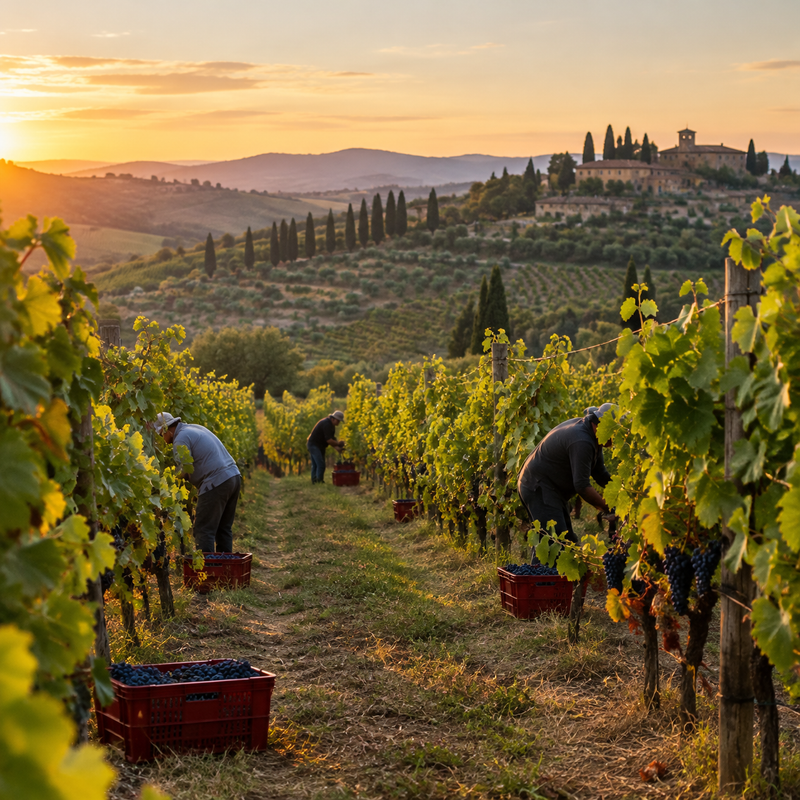
The climate is changing, vine growth cycles are accelerating and the rules of the past are becoming increasingly difficult to rely on. The 2026 harvest offers a clear illustration of this transformation. High temperatures, prolonged dry spells and significantly earlier ripening forced wineries to rethink their approach and respond with greater precision throughout the growing season.
According to the EFI Observatory, insights gathered from 18 Italian wineries reveal a diverse picture of the country’s latest harvest. Different territories, soil conditions and microclimates produced different outcomes, yet all shared one defining challenge: adapting to an increasingly demanding climate.
Heat is reshaping the harvest calendar
One of the most striking features of the 2026 vintage was the early start of harvesting. Across several Italian wine regions, picking began weeks ahead of the usual schedule.
In Oltrepò Pavese, Piedmont, Veneto and Lombardy, the first grapes were harvested as early as the first half of August. Pratello began on 10 August, approximately three weeks ahead of schedule, while Bosco del Sasso started on 14 August, around 15 days earlier than historical averages. In Valpolicella, Salvaterra also recorded ripening approximately two weeks ahead of normal.
The trend extended to regions traditionally associated with later harvests. In Barolo, Batasiolo brought forward its Nebbiolo harvest by around three weeks. In Montalcino, La Fiorita began picking Sangiovese on 8 September in the eastern sector, normally among the last areas to reach maturity.
This acceleration is about much more than timing. Picking at the right moment has become an exercise in precision, where continuous grape monitoring and detailed knowledge of individual vineyard parcels are essential to preserving balance, freshness and varietal expression.
The water challenge: managing drought without compromising balance
Water scarcity was another defining feature of the season. High temperatures and limited rainfall exposed vineyards to significant water stress, with varying effects depending on location, grape variety and soil composition.
In Valpolicella, Salvaterra experienced one of the hottest and driest summers of the past 50 years. In Sicily, Tenute Navarra benefited from the altitude and microclimatic conditions of its Butera vineyards, located between 350 and 400 metres above sea level. At LEA Winery, careful vineyard management, low-volume drip irrigation and night harvesting helped mitigate heat and water stress while preserving aromatic integrity.
However, conditions were far from uniform. Winter and spring rainfall played a crucial role in replenishing soil water reserves ahead of summer. Late-August rainfall also helped restore Glera’s hydration and physiological balance in Col dei Franchi’s vineyards after weeks of intense heat.
This diversity of outcomes highlights a fundamental point: there is no universal response to climate change. Vineyard management increasingly depends on strategies tailored to individual territories, with particular attention to water availability, bunch protection and changing weather patterns.
Lower yields, new opportunities for quality
A challenging growing season does not necessarily mean lower wine quality. This is one of the most interesting findings emerging from the wineries’ assessments.
Several producers reported yields below expectations or previous-year levels. Zýmē recorded a reduction of 30–40%, while Tenute Rubino reported a 15–20% decrease compared with 2025. LEA Winery, Tenute Baldo and Collefrisio also experienced lower-than-average production or reduced yields.
However, lower volumes did not necessarily compromise grape quality. In some cases, the season favoured greater concentration and excellent grape health. Zýmē reported outstanding sanitary conditions and more uniform ripening, with particularly promising prospects for red varieties. Cascina Chicco observed thicker berry skins, potentially contributing to deeper colour and greater phenolic structure, while Collefrisio highlighted particularly encouraging acidity levels in Montepulciano.
Batasiolo’s initial analyses also revealed promising phenolic and technological maturity in Nebbiolo.
The final quality of the wines will, of course, depend on winemaking decisions, fermentation management and ageing. Vineyard assessments point to encouraging potential, but the cellar will ultimately determine how successfully this translates into balance, complexity and ageing capacity.
Precision matters: every vineyard has its own response
If the 2026 harvest offers one clear lesson, it is that local knowledge and the ability to act at the right moment have become essential competitive advantages.
From canopy management to protect bunches against excessive sunlight, to night harvesting to preserve aromatic freshness, from irrigation strategies to parcel-by-parcel monitoring, producers demonstrated how precision in the vineyard can make a decisive difference.
Varietal responses further illustrate this point. In Valpolicella, Corvinone proved more resilient to extreme conditions than Corvina. At San Leonardo, the estate’s sheltered position and mountain shade helped preserve vine balance despite exceptionally high summer temperatures. In Montalcino, La Fiorita adopted a parcel-by-parcel harvesting approach, allowing each vineyard to reach its optimal stage of maturity.
In Alto Adige, St Michael-Eppan benefited from cool nights and stable weather, helping preserve acidity and freshness. In Sicily, altitude, ventilation and significant day-to-night temperature variations supported the ripening process across Tenute Navarra’s vineyards.
There was no single 2026 harvest. There were many, each shaped by its own challenges, opportunities and territorial identity.
Beyond the weather: the ability to interpret change
The 2026 harvest confirms a transformation that the wine industry can no longer afford to ignore: the future competitiveness of Italian wine will increasingly depend on the ability to understand change and anticipate its effects.
Climate sets new rhythms, but it does not determine the outcome on its own. Quality emerges from the interaction between terroir, grape variety, viticultural expertise and winemaking sensitivity. This balance is what enables producers to navigate challenging seasons without compromising their identity.
According to the EFI Observatory, 2026 was a demanding vintage, characterised by often lower yields and significant regional variations, yet with encouraging signs regarding grape quality across many of the wineries surveyed. The wines will require careful management in the cellar, but the season has once again demonstrated the strength of an Italian wine heritage capable of adapting, innovating and responding to change.
Because today, more than ever, making great wine means understanding the vineyard before harvesting its fruit.
DOWNLOAD THE FULL REPORT
Explore the complete analysis, data and insights from the 18 wineries featured in the EFI Observatory’s 2026 Harvest Report.